


Orient Express Dark Ride at Palace Amusements


|
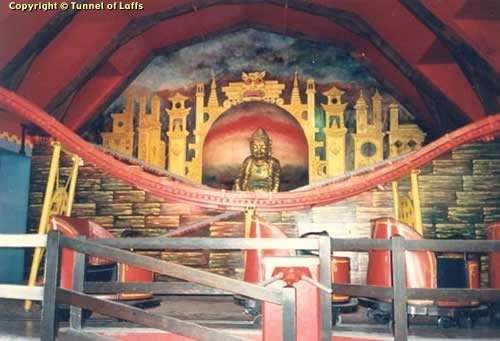
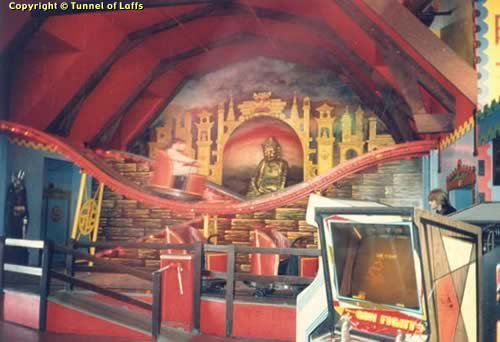
One of the flashiest rides to grace the Palace was the “Orient Express” dark ride, built and installed in 1960. This Asian-themed attraction was a popular favorite and reflected an era when the Western world held a great fascination with the mysteries of the Orient. Designed by the Pretzel Amusement Ride Company, it occupied the newer section of the Palace and replaced an earlier Caterpillar-type ride.
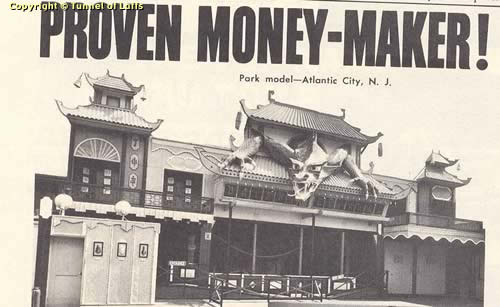
 While researching this dark ride, I wondered whether it was inspired by the legendary Pretzel attraction of the same name that once operated on an Atlantic City pier. Further research suggested that the Lange family had probably seen that Orient Express, whose elaborate façade and artwork were created by the late, great Bill Tracey. Its façade featured a huge fire-breathing dragon that billowed real smoke. Pretzel furnished six cars, the track and the ride’s operating system, while the Palace handled the artwork and installation.
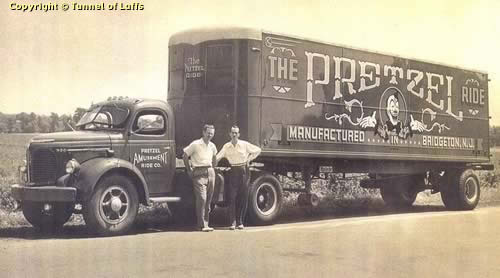
 The familiar Pretzel Company truck made another of the many deliveries associated with the approximately 1,200 rides the company sold over the years. This type of Pretzel ride was still quite new, having first been designed and marketed in the late 1950s. Numerous park models were sold to pier-based amusement parks throughout New Jersey, often under names such as “The Monster” and “The Lost Mine.” A classic Pretzel ride rolled out of Bridgeton, New Jersey, bound for the Jersey Shore, and the Palace received its new sure-fire thriller. The Lopez family created the artwork and stunts, with Ralph Jr. returning from the war just in time to help his father complete the ride. At the Langes’ request, a woodworker individually crafted the custom woodwork and fencing. Although the Palace attraction echoed the theme of its Atlantic City counterpart, it surpassed that ride in overall style and attention to detail.
 Let’s take a ride… From the loading station, the car turned left and passed through a set of doors into a room painted to resemble a raging inferno. This effective Lopez-team trick was later adopted by many other dark-ride artists. Ralph explained that they used a UV-sensitive, alcohol-based paint manufactured in Philadelphia by a company called Strobe Light. They striped the walls with “Radio Red” and basic black paint, then combined a black light with a strobe. By quickly switching off the black light and illuminating the room with red light and the strobe, they created a convincing “pulsating wall” effect. Other great dark-ride designers, including Bill Tracey and Jim Melonic, later used similar techniques. Simple, yet very effective!
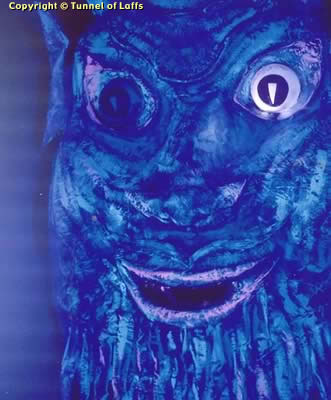 From the inferno room, the car passed through another set of crash doors and climbed the lift hill to the second floor. The lift, second level and speed hill were all exposed in the center of the façade, creating great ballyhoo for prospective riders. At the top of the lift, the car passed through another set of doors, where a giant head suddenly jumped up.
 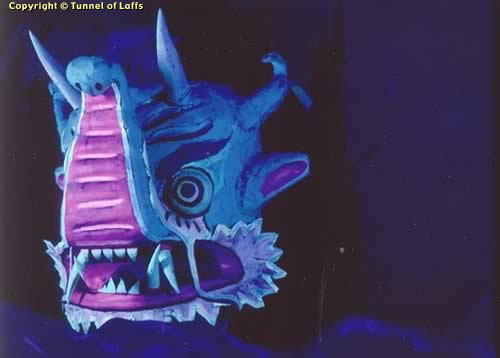 The car turned left toward a monster in a cage that reached through the bars at riders, then turned right toward snakes emerging from a large can. This was a common stunt used by several companies, including Funnie Frite and Tracey’s Amusement Displays. The car turned left, passed through doors onto the left balcony, then turned left again and reentered the façade.
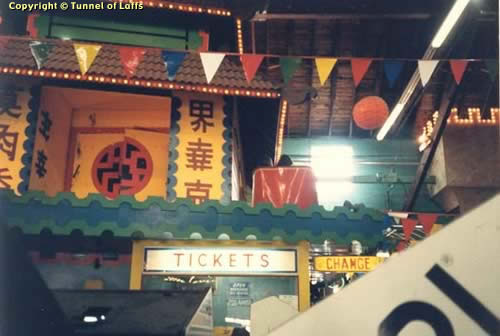
  Next, the car turned right as a loud siren sounded, crashed through another set of doors and descended the fast speed hill. It climbed the right side of the ride, reentered the second floor, veered right and passed through doors onto the balcony above ticket booth number one.
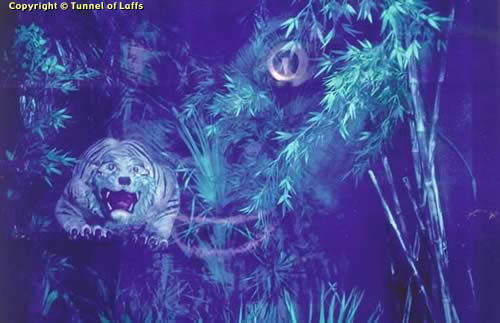
The car rounded the corner of the balcony and went back inside, where it faced the “Electric Gallery” and Ralph Lopez Sr.’s masterful “Hunter Shooting a Tiger” stunt. It then descended a curving hill to the left.
 At the bottom, the car passed through doors to a giant head with glowing eyes. This prop had originally appeared with the tiger but became a separate scene after the hunter was added. The car turned left toward an executioner chopping off a person’s head, another stunt created by Lopez Sr. The ultimate fate of this particular prop remains unknown. The car then turned right toward a skull with flashing eyes, a popular effect also used by Bill Tracey and Jim Melonic, as another alarm bell sounded. Finally, the car turned left toward a black-lit monster face painted in Day-Glo colors on the back of the first exit doors. The face illuminated just before the car passed through the doors. Two successive sets of exit doors, a feature common to Pretzel rides, helped keep the interior darker than designs that used only one set. The complete ride lasted approximately one minute and 50 seconds, with six Pretzel cars in operation.
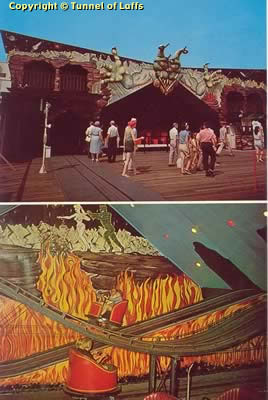 The Orient Express was an ambitious attraction, but the Palace may have underestimated the amount of space the ride required when installing it. This left limited interior room for additional stunts. Although the fast speed hill provided an exciting feature, the ride could not accommodate as many stunts as its large exterior suggested.
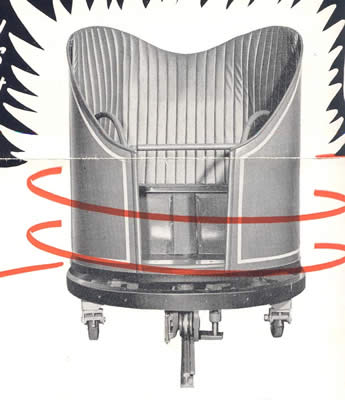
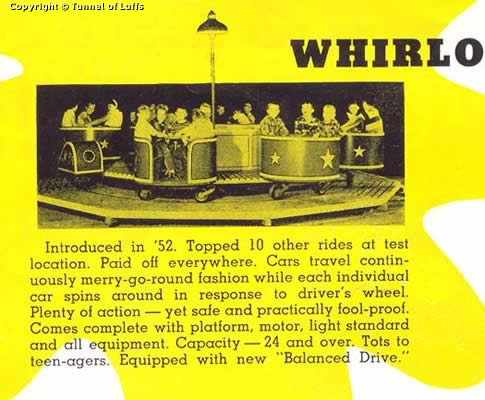
  The ride contained two Buddha heads: a large one dominated the center of the speed hill, while a smaller one stood elsewhere inside the attraction. The Palace also purchased a Pretzel “Whirlo” kiddie ride for this section of the building, but sold it after only a few seasons because management considered it boring.
 Nevertheless, the Pretzel Whirlo helped inspire a new generation of kiddie rides produced by numerous manufacturers. This area of the Palace also featured a “Bubble Bounce” ride for several years, along with a workshop hidden beside the Orient Express. Ralph Lopez Sr. created the ride’s props with assistance from Ralph Lopez Jr., while the two Buddha heads came from a theatrical-supply company in New York City. According to the history shared for this article, the Buddha figures originally displayed swastika symbols, which the Palace later painted over. The Orient Express was eventually sold almost in its entirety to a private collector. Most of the attraction reportedly remains in a storage trailer in New Jersey, awaiting a new home. A few props were sold separately; the two Buddha heads and the snake stunt are also believed to remain in New Jersey. I wish to thank Brian Maher for his help and insight concerning the Orient Express layout.
Let's go to Hell n Back


|
 |
Contents © 2002 Tunnel Of Laffs unless otherwise noted. All rights reserved.
Tunnel Of Laffs is not affiliated in any way with the Amusement Parks listed at this site.
Use of photos, text, and other materials only with the permission of Tunnel of Laffs.